Imagine a program in Germany where you can study, work, and get paid every month.
Sounds amazing, right?
That program actually exists and it’s called Ausbildung.
Ausbildung is a vocational training program in Germany that lets you learn theory in school and practice it directly at a company. The best part? You get paid while learning.
Here’s the simple explanation of how it works.
What Is Ausbildung?
Ausbildung is a unique vocational training program in Germany designed to help people start a professional career through hands-on experience. Unlike traditional university studies that focus mainly on theory, Ausbildung combines classroom learning with paid work experience in a real company. This dual system makes Ausbildung one of the most practical education models in the world.
A Dual System: School + Work
Ausbildung works through a dual education system, which means you receive two types of training at the same time:
1. Vocational School (Berufsschule) – Theory
At school, you learn:
- Basic knowledge related to your profession
- German language for work
- Math, communication, and workplace rules
- Technical concepts you will later use on the job
Classes usually happen 1–2 days per week (depending on the field).
2. Company Training (Practical Work)
At the company, you:
- Work like an employee
- Practice real tasks
- Learn directly from skilled professionals
- Build experience that companies truly value
This part usually takes 3–4 days per week.
Because companies invest time and resources in training you, they pay you a monthly salary, even while you are learning.
Why Germany Uses the Ausbildung System
Germany created the Ausbildung system to ensure that:
- Young people have solid job opportunities
- Companies get well-trained workers
- The economy stays strong with skilled professionals
It’s one of the reasons Germany is known for excellent workers and high-quality industries.
Who Can Join Ausbildung?
Ausbildung is open for:
- German citizens
- EU residents
- International students from all around the world
As long as you meet the requirements (usually a high school diploma and German language B1/B2), you can join the program.
Popular Ausbildung Fields
Germany offers more than 350 different Ausbildung professions. Some of the most popular and in-demand ones include:
✔ Nursing (Pflegefachkraft)
Very high demand, stable career, and one of the highest trainee salaries.
✔ Hospitality (Hotel & Restaurant)
Perfect for people who enjoy customer service and working in an international environment.
✔ IT Specialist (Fachinformatiker)
Great for tech lovers, with strong job opportunities and good pay after graduation.
✔ Engineering / Mechatronics
Ideal for those who love mechanics, machines, and technology.
✔ Office Administration (Büromanagement)
A good choice for those who prefer office work, paperwork, and organization.
✔ Culinary Arts (Koch/Köchin)
For those passionate about cooking and kitchen work.
What Makes Ausbildung Special?
Here are reasons why Ausbildung stands out compared to other education paths:
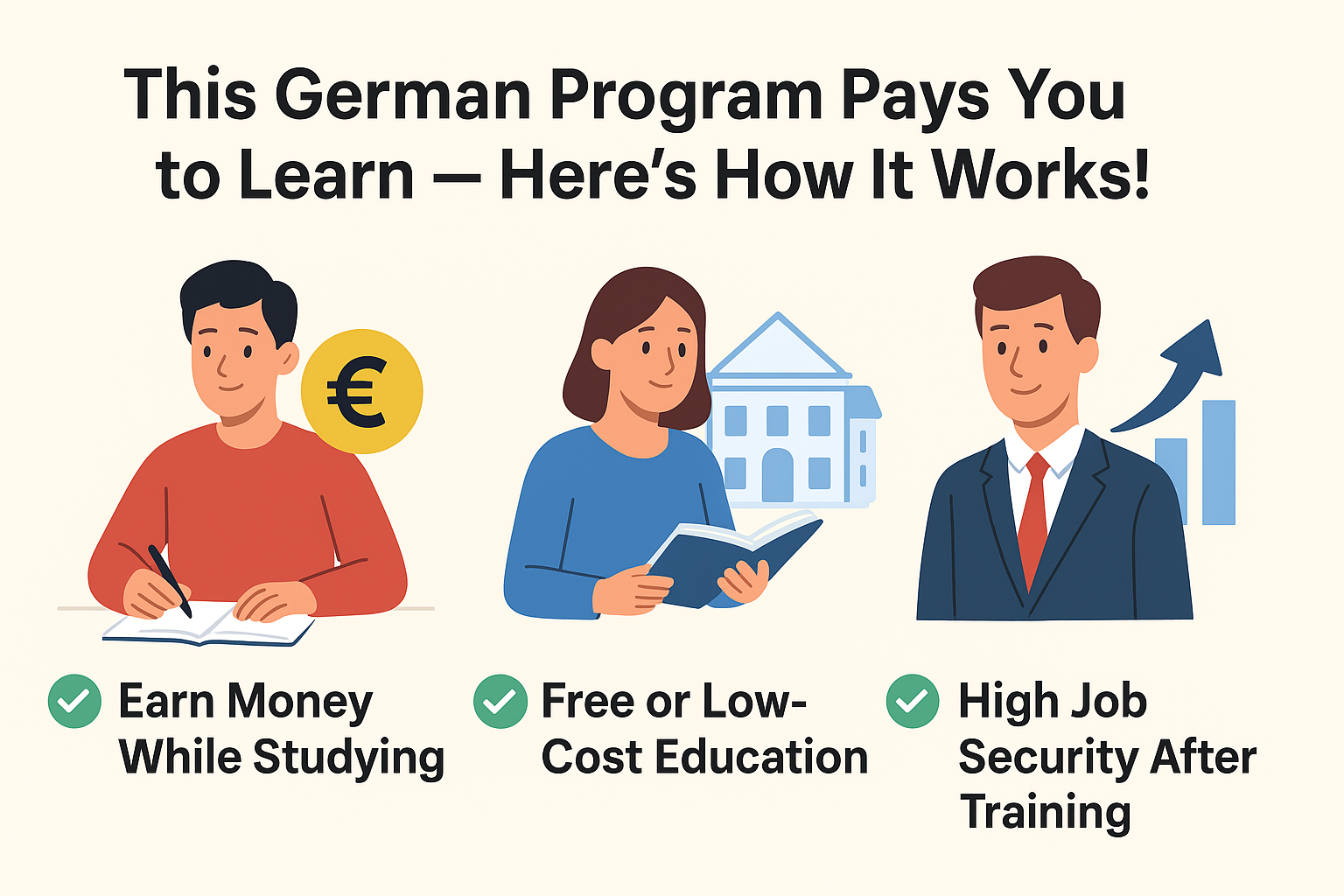
1. You Earn Money While Learning
Students receive a monthly salary (between €800–€1,300).
2. Free or Very Low-Cost Education
Most vocational schools have no tuition fees.
3. Real Work Experience
When you finish, you already have years of experience not just a certificate.
4. High Chance of Being Hired
Many companies hire their trainees immediately after the program.
5. International Recognition
A German Ausbildung qualification is respected worldwide.
6. Pathway to Long-Term Residence in Germany
Completing Ausbildung + working for a few years can lead to a long-term visa or even permanent residence.
Who Should Consider Ausbildung?
Ausbildung is perfect for people who:
- Want a career, not just a degree
- Prefer learning through doing, not only reading
- Want to move to Germany
- Want a stable job with high demand
- Want to earn money while studying
Whether you’re fresh out of high school or looking for a career change, Ausbildung can be your pathway to a stable future in Germany.
How Does Ausbildung Work?
Ausbildung follows Germany’s dual training system, which means you learn in two places at the same time: a vocational school and a real company. This system makes Ausbildung highly practical, career-focused, and perfect for people who want real experience, not just theory.
1. Split Between School and Work
Every week during Ausbildung, your schedule is divided into:
Vocational School (Berufsschule) — Theory
You study:
- Professional knowledge for your chosen field
- Workplace rules and German employee rights
- Communication, teamwork, and customer service
- German language for professional use
- Technical subjects relevant to the job
Classes usually happen 1–2 days per week, or sometimes in blocks (e.g., 2 weeks of school, then several weeks of work).
Company Training — Practical Work
At the company, you:
- Work like a regular employee
- Learn directly from experienced professionals
- Practice real tasks
- Rotate through different departments
- Build skills that make you job-ready
This part usually takes 3–4 days per week.
The best part?
You get paid every month, even though you are still in training.
2. Program Duration
Ausbildung typically lasts:
2 to 3.5 years
The length depends on:
- Your chosen profession
- Your performance
- Your school schedule
- Whether you have previous qualifications
Example durations:
- Nursing → 3 years
- IT → 3 years
- Hospitality → 2–3 years
- Mechatronics → 3.5 years
You can also shorten your Ausbildung if:
- You have excellent grades
- You already have related experience
- You speak German at a high level
3. Open for International Students
Germany welcomes international students into Ausbildung. People from:
- Asia
- Africa
- Latin America
- Middle East
- Europe (non-EU and EU)
…can all apply as long as they meet the requirements.
General Requirements:
- Finished high school
- German language level B1 or B2
- Good motivation and willingness to learn
- Valid Ausbildung visa (for students outside the EU)
Every year, Germany actively recruits thousands of international trainees because the country needs skilled workers.
4. Monthly Salary During Training
One of the biggest advantages of Ausbildung is that you earn money while learning.
Average salary range:
- Year 1: €800–€1,100
- Year 2: €900–€1,200
- Year 3: €1,000–€1,300
Some fields pay even more (e.g., nursing, IT, engineering).
This salary helps you cover:
- Rent
- Food
- Transportation
- Insurance
- Daily expenses
Unlike university students, Ausbildung students do not need to pay tuition fees the company covers the costs.
5. Full-Time Employment After Graduation
After completing Ausbildung, you receive a nationally recognized qualification called “Berufsabschluss.”
Most companies offer a job immediately because:
- They already trained you
- You know the work
- They invested in your skills
Many graduates earn:
- €2,200–€3,000 per month at the start
- Higher earnings as they gain more experience
6. A Pathway to Long-Term Stay in Germany
Ausbildung is one of the easiest paths to a long-term life in Germany.
After graduation, you can:
- Get a full-time work contract
- Apply for a skilled worker visa
- Eventually apply for permanent residency
Many international students use Ausbildung as their gateway to living and working in Germany permanently.
Why Ausbildung Works So Well
- You study and work at the same time
- You gain real skills that employers want
- You earn money while learning
- You get a clear career path
- You have a high chance of being hired after finishing
- It is open to students from around the world
- It can lead to long-term residency in Germany